In 1979 agreement was reached by EU countries to restrict hunting of various species of wild birds. Yet the French LPO (bird protection league) says that forty years later in several instances France has yet to comply with the directive.
Some 68 species deemed at risk are still hunted in France, including 20 on the international endangered list. This is against an average of 20-30 in the rest of Europe.
The LPO also wants to put a stop to some "traditional" methods of trapping birds, such as the use of "glu" as we reported here a couple of months ago. The method has already been banned in Italy, Spain and Malta, but not yet in the French departments where it still goes on.
Thirdly the league wants to prevent the hunting of migratory birds beyond the end of January, whereas chasseurs want the season to include February. The league claims to have asked the state to ban this some 12 times and have now exhausted all internal avenues. Consequently they are to ask the EU commission to remind France of its obligations under the EU directive. It is no use, they say, to preach France's leading position in pursuit of bio-diversity and fail to set a good example on this measure of protection of wild life.
Showing posts with label Birds. Show all posts
Showing posts with label Birds. Show all posts
Wednesday, 3 April 2019
Wednesday, 10 January 2018
Organic bird food
Rachel Shamash writes
If anyone is interested in buying ORGANIC bird food ( sunflower
seeds) I have found a French source/farm near Puylaroque. He will be sending it
all for oil soon so you will need to make contact soon. He sells it at 70
centimes a kilo. Please email me or phone to have his contact details. You will
need to take a bag (or two) and bathroom scales but i can also regroup people
to go at the same time if there are several
interested. rachel.shamash@orange.fr 05 63
24 07 34

Thursday, 7 December 2017
Winter visitor
Our bird feeder is attracting lots of interest and not just the usual suspects. Apart from tits of all sizes, nuthatches, woodpeckers and various finches we were pleased to spot a brambling this morning. A species which spends its summers in Scandinavia and comes south for the winter. Probably more common in the UK than here, the brambling is a mid-sized finch with distinctive colour markings. Their preferred habitat is woodland, especially birch, but as seed eaters they are clearly attracted to our sunflower seeds, and may be just passing here to more productive areas. Having had daily visits from the hawfinch we would now like to see a bullfinch, so much scarcer here.


 |
| Brambling with siskin and blue tit. |
Friday, 24 November 2017
Feed the birds
The unusually mild autumn has led us not to put out our bird feeders until these last few days. But even now a feeder full of sunflower seeds is lasting a few days instead of a few hours in midwinter.
The usual flocks of blue and great tits are still sparse, but we were rewarded with a small group of finches, chaffinches, siskins and unusually a hawfinch. Surprisingly few green finches, but whatever you expect some seeds and nuts, plus water supplies will all be welcome by the wild birdlife.
 comments to taglines82@gmail.com
The usual flocks of blue and great tits are still sparse, but we were rewarded with a small group of finches, chaffinches, siskins and unusually a hawfinch. Surprisingly few green finches, but whatever you expect some seeds and nuts, plus water supplies will all be welcome by the wild birdlife.

Tuesday, 18 July 2017
He is common
But still the common buzzard is a fine sight. Generally we see the pair wheeling above with their cat like call, but today we were honoured with a garden visit. Standing on the ground or perched on a fence post he hung around long enough for a few shots.


 comments to taglines82@gmail.com


Sunday, 16 July 2017
A rare sight
You hear them when walking, you hear them when they are attacking your figs and occasionally you see one flash by in a blur of yellow and black. Golden Orioles (loriot in French) have a very distinctive voice but tend to hide away at the tops of trees.
So it was unusual to see this chap perched on a dead branch in our acacia this morning. The bird stayed just long enough to fire off this shot.
comments to taglines82@gmail.com
 Y
So it was unusual to see this chap perched on a dead branch in our acacia this morning. The bird stayed just long enough to fire off this shot.
comments to taglines82@gmail.com
Wednesday, 3 May 2017
Bearded vultures released
The bird, also known as a lammergaier, is being reintroduced into the high causses in Aveyron by the LPO (French equivalent of the RSPB). The plan is to create a group of these birds - the only one of its genus - which will re-populate the area from the pre-Alps to the Pyrenees. The birds were raised in captivity in Spain and Hungary.
 |
| bearded vulture - gypaete barbu |
Tuesday, 25 April 2017
Crash landing
It is so sad when small birds crash into your plate glass windows. Last week a blue tit had inadvertently entered via an open door and spent time flying from one window to another until eventually it killed itself -despite us opening as many doors and windows as possible. Today this little chap hit our window with such force that feathers flew in all directions.
 Happily he recuperated on the window sill (formally forbidden to all cats) for about an hour before fluttering off into the bushes.
His size, beak and markings suggest he is a male cirl bunting, something we don't see to often.
comments to taglines82@gmail.com
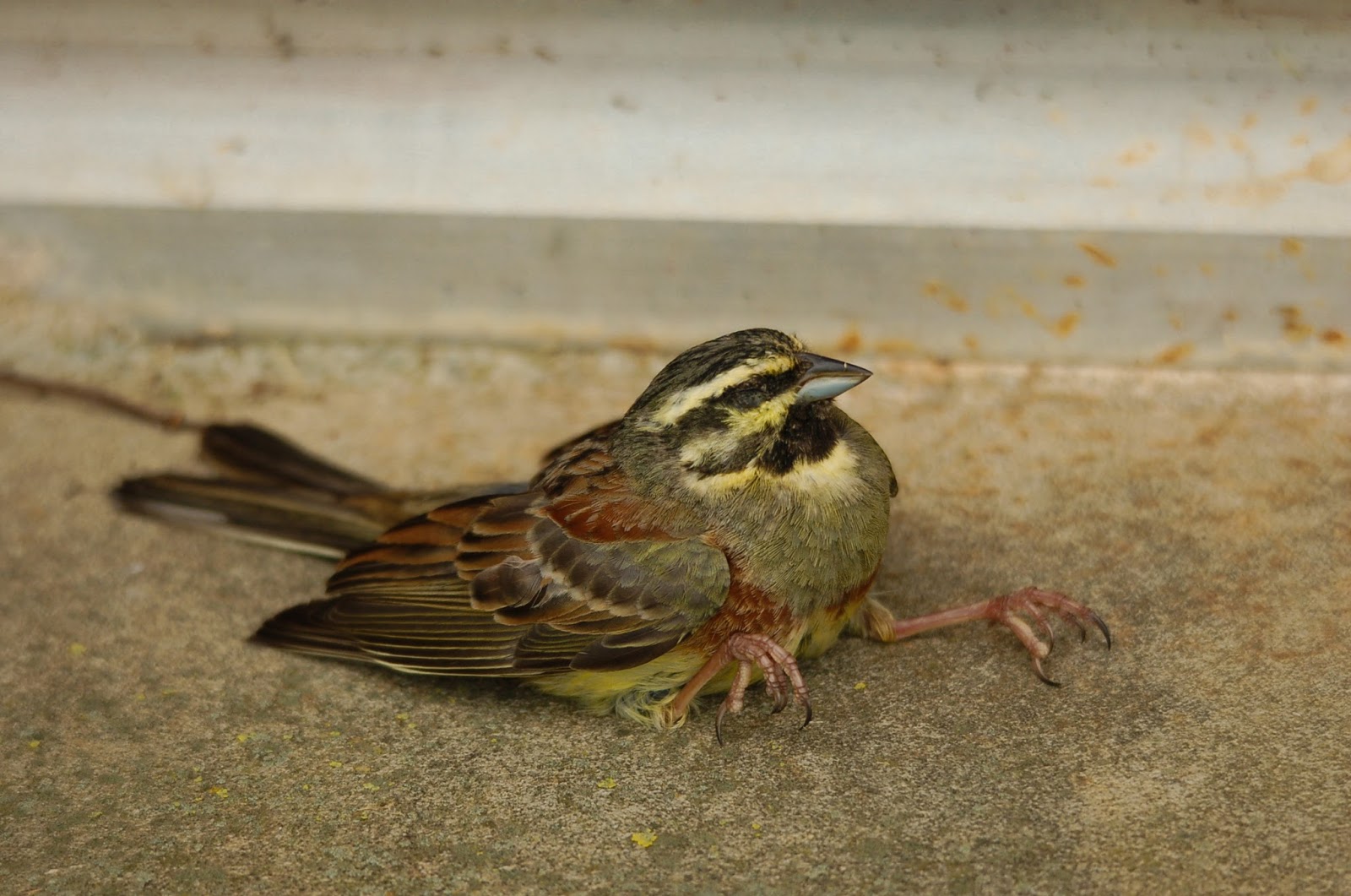
His size, beak and markings suggest he is a male cirl bunting, something we don't see to often.
comments to taglines82@gmail.com
Sunday, 16 April 2017
Was it a tern?
Walking the dogs by the Aveyron yesterday morning (Saturday) we joined a small group of French people marvelling at the beautiful sight of a bird we had not seen before on the river. The size of a small pigeon, but slightly and elegantly built, the bird flew up and down the river, swooping and occasionally diving, catching insects and possibly small fish. It looked to be white, with a black head and underparts. Sadly with no camera to hand only mobile phone snaps were possible and too indistinct to publish.
Research suggests it was a black tern, an inland variety of the common sea birds. Probably migrating to some other area, black terns (and their white-winged variety) live primarily in marsh land, lakes and river areas. They do not perch in trees generally, but will land on the ground.
If anyone can confirm the sighting, preferably with a photo, we would be delighted.
comments to taglines82@gmail.com
Friday, 3 March 2017
Here's an early bird
Having spotted a flight of cranes heading over north east bound a couple of days ago we were disappointed to be too late with the camera (a lot of indistinct dots in the distance), we were delighted to see this hoopoe land in the acacia tree outside our window. He was struggling in the strong wind and refused to deploy his crest, but here is a nice shot of an early visitor.
 |
| Huppe fasciée: hoopoe |
Saturday, 7 January 2017
Counting red kites
 |
| Milan Royal: red kite |
comments to taglines82@gmail.com
Monday, 17 October 2016
This little chap was OK
Coming into the house we found a tiny bird dazed on the ground. Probably he flew into a window as so many do. We picked him up
and carried him to a safe looking post in the field (away from cats) where he/she rested for 10 minutes before flying away. He may be a chiffchaff or similar warbler No doubt some ornithological expert will let s know.
 |
| Nestles in Malc's hand |
 |
Tiny chap, now safe.
|
Friday, 9 September 2016
Storks passing through
Passers-by in the Pyrenean town of Foix were surprised to see dozens of storks resting in various locations about the centre. Storks migrate to southern Africa, many using the western route via Spain. It is not known why they decided to rest at Foix, but probably meteorological conditions reduced the thermals the birds need to soar on as they are too big to be able to flap their wings for long periods.
comments to taglines82@gmail.com
 |
| Storks resting on a school roof in Foix on Thursday. |
Sunday, 17 April 2016
Spring is sprung; the grass is ris...
and the birdies is definitely here. Morning walk this morning was serenaded by cuckoos and nightingales with swallows whizzing around looking to dip in the pool. Having already spotted a hoopoo, bird-watching is definitely getting more interesting. As well as the kestrels we also have a blue tit family nesting in the balcony wall and several goldfinch couples in the various cypress trees around the garden. But no redstarts as yet.
comments to taglines82@gmail.com
comments to taglines82@gmail.com
Saturday, 9 January 2016
Counting kites

comments to taglines82@gmail.com
Friday, 17 July 2015
He shot a red kite
A chasseur (hunter) in the Pyrenees shot and killed a red kite (milan royal) , a bird which is in decline in France and is protected. He was seen by wardens and charged. In court in Tarbes he was fined 2500 euros (1900 suspended for 5 years), had his chasse licence revoked for 12 months and ordered to pay 500 euros compensation to the LPO (French equivalent of the RSPB) and Nature Midi Pyrenees who both brought cases against him.
 Hunters and their associations are always justifying what they do as being pest control but it is hard to see these magnificent birds as pests in the high mountains.
comments to taglines82@gmail.com
 Hunters and their associations are always justifying what they do as being pest control but it is hard to see these magnificent birds as pests in the high mountains.
comments to taglines82@gmail.com
Wednesday, 24 June 2015
Bird makes light work of candle
When we took refuge from the heat of the afternoon in our grange we wondered what the knocking noise was - a bit like a woodpecker or nuthatch pecking away. We eventually spotted the culprit - a great tit. He was flying on to a shelf with some candles and pecking away at one of the wax offerings, but always the same one. It was quite a big white candle; the blue one eschewed. Perhaps it is a beeswax candle whereas the others are paraffin. Here he is having a quick wax snack.


comments to taglines82@gmail.com
Tuesday, 16 June 2015
Peregrine falcons at Albi
These birds of prey have been nesting in the spire of the cathedral for nearly 20 years now and as with many such places here and in the UK they help control the pigeons.
The mairie at Albi has produced a leaflet in English as well as French giving the background to their life at the top, as well as detailing the cooperation with the LPO to install web cameras.
The birds had their own blog at http://fauconpelerin.mairie-albi.fr/ which has several videos shot during 2012 and this year's brood of 4 have now fledged, their progress monitored on the city's parks and gardens blog.
comments to taglines82@gmail.com
Wednesday, 27 May 2015
Well meaning but wrong!
We were in the vets today making an appointment for Eldo's snip. We got talking to the vets wife who is also the receptionist. We told her about our baby kestrels high in a nest in our gite wall.
She had a better tale to tell.
Last week a man arrived with a cage, inside was a baby owl he had found on a post by the roadside. Not just any old owl but a " Grand Duc" an Eagle owl, the biggest owl of all. The man had seen it on the post and as it could not fly and he thought it was abandonned had performed he thought a rescue!!!!
Owls, like kestrels, when fledged take two days before they can fly properly; they tend to choose a perch and parents continue to come and feed as they would have done in the nest. In the two days the fledglings test and stretch their wings till their flying skills come in to their own.
It is not too sad a story as the vet quickly phoned the LPO, the society here for birds; the young owl was quickly taken off to be fed and caged for a few days till it could be released.
The morale here is leave any young bird that you think is in trouble; its parents know where it is and are busy foraging to feed it and its brothers and sisters.
Comments to taglines82@gmail.com
Thursday, 14 May 2015
Grub up
 Working in the kitchen yesterday (Malc, not me) we watched a pair of blue tits who have nested in the wall above the window working furiously to feed a brood of youngsters.
They refused to be there just as the camera was ready, and the camera was never ready when they were there.
But here is a hurried snap of a lunch delivery for some hungry beak.
comments to taglines82@gmail.com
Subscribe to:
Posts (Atom)